Understanding why a “minor” crash can still affect the human body
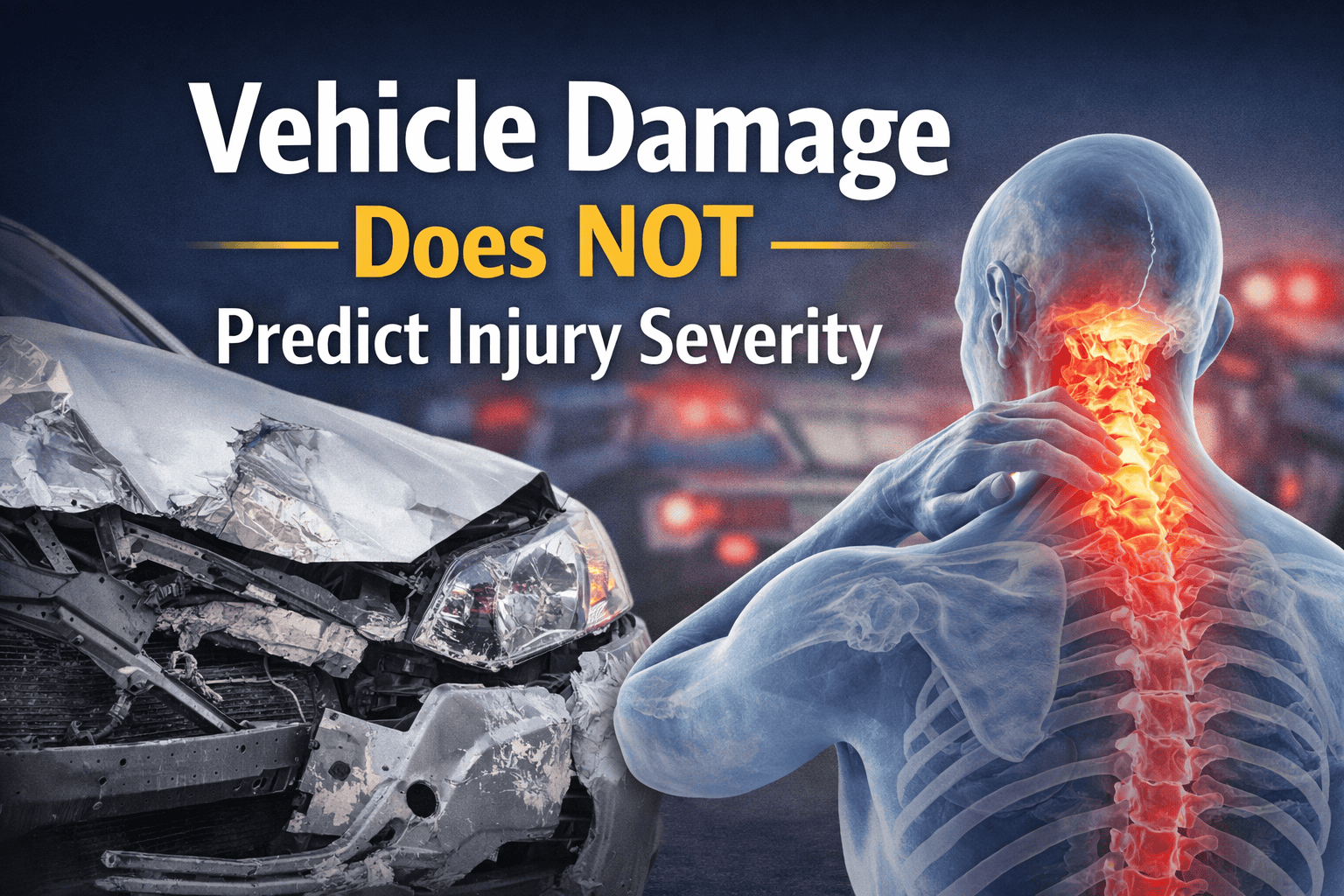
Many people assume that the severity of injuries after a car accident should match the amount of visible damage to the vehicle. If the car looks relatively intact, the assumption is often that the occupants must be fine.
Clinically, that is not always the case.
Vehicle damage and bodily injury do not correlate as directly as many people expect. Understanding why requires looking at how modern vehicles are designed and how the human body responds to sudden forces.
Modern Vehicles Are Designed to Limit Damage, Not Predict Injury
Modern vehicles are engineered with structural features intended to manage collision forces, but how those features behave depends heavily on impact speed. At lower speeds, where the majority of collisions occur, many vehicles are designed to withstand impacts without visible deformation. In practical terms, modern bumpers and frames have been stiffened to reduce repair costs and limit property damage in low-speed crashes, often up to approximately 10–12 miles per hour.
While this design approach may reduce visible vehicle damage, it does not mean that forces are reduced for the occupants inside the vehicle. When a vehicle structure remains rigid during a collision, more force can be transferred through the cabin, exposing the body to rapid acceleration and deceleration.
Safety features that are effective at reducing catastrophic injury during high-speed crashes are not designed to mitigate the subtler biomechanical stresses that occur at lower speeds. In these scenarios, the vehicle may appear largely intact while the occupant experiences significant inertial forces that strain muscles, joints, ligaments, and connective tissues.
As a result, the absence of visible vehicle damage does not reliably indicate that the body was protected from injury.
The Human Body Responds Differently Than a Vehicle Frame
Unlike a vehicle, the human body does not have engineered crumple zones. The head, spine, and extremities are subject to inertia, meaning they continue moving when the vehicle suddenly stops or changes direction.
This can place stress on muscles, ligaments, joints, intervertebral discs, and neural tissues. These structures may be strained at a microscopic or connective-tissue level without immediate pain, swelling, or obvious signs of injury.
Because these changes are not externally visible, injuries can be underestimated in the immediate aftermath of a collision.
Why Symptoms May Not Be Immediate
After a collision, the body often enters a stress response. Adrenaline and other stress hormones can temporarily suppress pain perception and muscle guarding. At the same time, inflammation and tissue irritation develop gradually.
This helps explain why people may feel “fine” initially, only to develop symptoms such as neck pain, back pain, headaches, shoulder or knee discomfort, dizziness, or cognitive changes days later.
Delayed symptom onset does not mean that nothing happened at the time of the crash. It reflects how the body processes trauma over time.
Injury Severity Is About Force Transfer, Not Appearances
From a clinical standpoint, injury risk is influenced by factors such as speed change, direction of impact, body position, and individual tissue characteristics. Visible vehicle damage is only one variable and is often a poor indicator of what the body experienced internally.
For this reason, healthcare providers evaluate patients based on symptoms, physical examination findings, and functional changes rather than vehicle appearance alone.
A Final Thought
A car can look relatively intact while the body inside absorbs rapid changes in motion that strain muscles, joints, and connective tissues. Understanding this distinction can help explain why injuries sometimes occur even after seemingly minor accidents.
For those seeking additional information after a collision, guidance from a fellowship-trained auto accident chiropractor can help clarify whether symptoms are consistent with injury and what next steps may be appropriate. Educational resources are available at SpineNJ.com, and my office remains available as a local resource for individuals with questions following a motor vehicle accident.
Author
Jordan Kovacs, DC, FPSC
Chiropractic Physician, Eatontown, NJ
Advanced training in evaluation and management of motor vehicle–related injuries